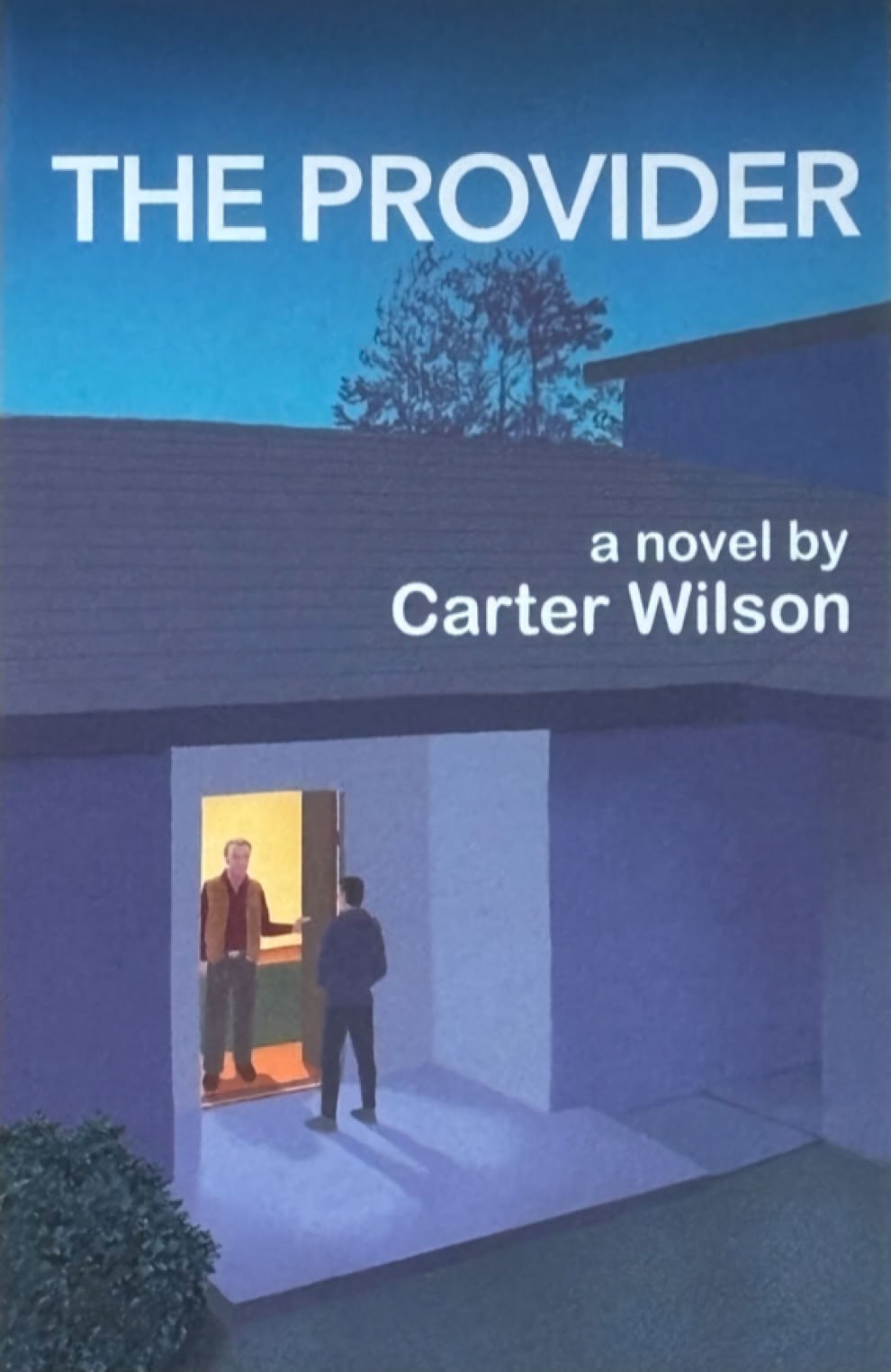
Set on Chicago’s North Shore, THE PROVIDER concerns a married working guy who begins browsing the internet for hook-ups with other men. Not imagining casual motel sex would upset the apple cart, he discovers “feelings” for a wealthy, old-family gentleman. Is this love? Or just trouble?

LA Blade Interviews Author Carter Wilson About His New Novel
The LA Blade sat down with Carter Wilson, novelist and anthropologist, to discuss his new novel “The Provider.”
Wilson is best known for his 1980s gay bestseller about a fictional photographer on the expedition where the Inca ruins at Machu Picchu were “discovered,” featuring a love story between the photographer and a Peruvian guide. With co-writer Judith Coburn, Wilson contributed Harvey Fierstein’s narration for the Oscar-winning documentary “The Times of Harvey Milk,” and wrote Dustin Hoffman’s narration for “Common Threads,” which also won an Academy Award. Wilson’s research on gay Mexico enabled him to help gay men seeking asylum in the U.S. as members of a persecuted minority.
Los Angeles Blade: What is your novel “The Provider” about?
Wilson: A married contractor approaching 40 decides to give in to his curiosity about casual sex with other men. When he meets a wealthy older man, he finds himself falling in love.
Los Angeles Blade: What’s special about your main character?
Wilson: Jake Guarani has always prided himself on being a sexually accomplished ladies’ man. In ten years of marriage, however, he has not cheated on his wife. He’s the “provider,” working hard in the construction business to take care of his family—something he’s both proud of and resents. Though brash and forthright, Jake also has his insecurities. Through friendship with a school pal, he was raised around North Shore of Chicago wealth, so the casual put-downs of his clients and co-workers hurt. At one level, “The Provider” is about how sex and class work together—or don’t.
Los Angeles Blade: Why did Jake wait so long before exploring his sexual interests in other men?
Wilson: The conventional demands of his life and profession kept him from allowing himself to think seriously about that side of himself. Now the internet has helped make hook-ups easier to arrange.
Los Angeles Blade: In the story of a “straight” guy’s affair with another “straight” guy, what will be of interest to people in the lesbian and gay community?
Wilson: Well, it’s a love story. Though it’s a clichй, in the past lesbian book people assured me that women were buying my fiction because they love a love story. How other people of any stripe manage the difficult waters of sex, relationship, and obsession is always a strong pull.
Los Angeles Blade: Where did the impulse to tell this particular story come from?
Wilson: From talking with married men who have sex with men about how they handle the complications, contradictions, and the fun.
Los Angeles Blade: About a quarter of the way into “The Provider,” the reader encounters a lot of graphic descriptions of sex between the two main characters. Why is this?
Wilson: Jake, my protagonist, is also a “provider” in the sense that he gets off on pleasing his partner. It is sexual hunger which brings him and the older guy together in motel rooms and then leads them along into something else. (I had a friend who used “motel” as a verb: “My cousin used to come by and motel me,” he would say.) The two men get to know each other primarily in these brief interactions. So I couldn’t go dot-dot-dot on the subject of bodies and hearts and minds when all three are in play.
Los Angeles Blade: Is it easy for you to write about sex?
Wilson: Ha! I started to say it’s not easy for me to write about anything, but after so many years at it, that’s not exactly true anymore. The hardest part of writing about sex is avoiding the clichйs. They crop up all around. Equally hard is letting the reader feel the wonders which sometimes attach to the physical acts.
Los Angeles Blade: Is there really some distinction between “erotic writing” and porn?
Wilson: My friend Jay Cantor says erotic writing may just be “the higher porn.” The difference, however, is real. In a XXX movie, telling the pizza man you don’t have any change but you’d be glad to get horizontal with him in the bedroom might suffice. But it is just not enough for character-based and memorable erotic writing, the kind of thing you find in D.H. Lawrence or Flaubert.
Los Angeles Blade: You say “class” is seldom related to sexuality these days. Why is that?
Wilson: Mainly because in our current culture, we pretend that social class with all its weird markers and its cruelties does not exist. Ethnicity (or gayness) blankets a lot of our troubles that are really about class. Jake Guarani is proud of being a working guy, but the fact he’s pleasuring a patrician, old-family fellow is a large part of the affair’s turn-on for him.
Los Angeles Blade: What is your feeling about what “bisexuality” is really about?
Wilson: We often talk about bisexuality in very sloppy and unhelpful ways. Take me as an example. I have been out of the closet for 47 years. I have not had sex with a woman for 41 years. I identify as being gay (I sometimes excessively shout it from the rooftops). Yet given the experiences of my past, am I technically somehow still really “bi”? But the interesting problem lies deeper than that. It lies in what theorists of sex call “sexual object choice.” Is it possible not to have some kind of long-term preference for men or women? And if so, how many people are there really like that? When a psychiatrist friend tells Jake he thinks Jake is that relative rarity—a “true” bisexual—Jake asks if that means there’s some kind of discount or something he hasn’t been putting in for.
Los Angeles Blade: Why are gay men sometimes suspicious of men who claim to be bi?
Wilson: In one way the suspicion is justified. Being heterosexual remains a privilege despite all we’ve done to equalize things. So proclaiming yourself bi can be a way to cling to hetero privilege while also enjoying all the fruits of being queer. (I was going to say the fruits of being a fruit, but I won’t.) However, I’m against the cynicism in judging others that way. That’s some of what “The Provider” is all about.
Los Angeles Blade: Six novels, nonfiction, a children’s book, film work. You’ve had a long and varied writing career. Are there common themes that hold it together?
Wilson: I’m old enough to have passed through the so-called sexual revolution of the 1960s and ’70s, a time for which I remain grateful, as it gave me the… well… balls to come out. The idea that the liberation of the body and the exploration and fulfillment of desires would elevate and enlarge the mind and the spirit remains strong in me. My other fascination has been Mexico and especially Mayan people there. Three of my novels take place in the state of Chiapas, and I think there was liberation from middle-class fuddy-duddyness in getting to know a second culture as well as I could.
Los Angeles Blade: Working on two Academy Award-winning documentaries must have been fun, yes?
Wilson: Fun yes, but also hard work done under a lot of time pressure. The narration of a feature-length documentary is like one long poem, and you have to be able to hold everything you need to say in your head and not repeat or even echo yourself. Especially on “Harvey Milk,” my co-writer and I got to contribute to the structuring of the film when the director and others had worn themselves out trying different possibilities.
Los Angeles Blade: You’ve also done a good deal of movie writing.
Wilson: Yes, though nothing that ever made it all the way up to the big silver. Dramas with friend Tim Hunter, original comedies with Judith Coburn, an adaptation of John Webster’s Jacobean melodrama “The White Devil” with Tim, and by myself a screenplay for Christopher Isherwood’s excellent first American novel “The World in the Evening.”
Los Angeles Blade: Are there things you learned from film writing that help writing fiction?
Wilson: A good rule for movies is always to know where your main character is. Where did we see her last and when will she show up again? In fiction this is less necessary, but if you keep to it, you won’t wander off and lose time on peripheral stuff you’ve later got to cut. Of course, the big difference between fiction and film is that unless you have a voice-over narrator, in a feature you can’t just say “The next morning Winky woke up with a hangover as big as the Ritz.” You have to indicate all that somehow. Well, you can put up a card, “Six Years Later in Amalfi, Italy” but that’s a little shoddy usually.
Los Angeles Blade: Tell us a little about your work on gay asylum cases from Mexico.
Wilson: In the 1990s under Janet Reno, the Department of Justice allowed prejudice against gay men and women and people with HIV in Mexico to become a reason for them to seek asylum in the U.S. The standard, however, was strict—you had to have a reasonable fear for your own life if you were returned to your country of origin. Because on my anthropological side I had studied and written about gay life and HIV in Mexico, I was able to serve as an expert witness in over 60 cases in immigration court. Most of this was pro bono work, and it was great to be able to use my “academic” knowledge to help others. You don’t encounter that possibility very often in universities.
Los Angeles Blade: Do you have a next project?
Wilson: I have a nonfiction story called “Happy Monet Christmas, Darling” which is about actress Martha Hyer having hubby producer Hal Wallis’s great Impressionist paintings copied and sold off, which I’m preparing for publication. Ad line: ‘Skulduggery in the ranks of Hollywood Royalty.’
Los Angeles Blade: What’s your life like now?
Wilson: Quiet. Retired from the University of California Santa Cruz for 22 years, live within sight of the ocean (we can hear seals on the beach on winter nights when the wind is right), husband who prefers his cooking to mine, a lot of satisfaction with life, though I’m trying not to be piggy or smug or intolerable about that.
Los Angeles Blade: Any regrets?
Wilson: A younger and better-looking writer, 54, apparently has the same birth name as mine, and his production of thrillers and suspense has “blanketed” me some on Amazon and the Wiki. You can’t copyright a name. It was OK with me when a “Carter Wilson” from Virginia became Miss World America 1979. I told everyone I did OK in bathing suit and gown, but got lower marks in talent for my juggling on a unicycle act.
Los Angeles Blade: Do you sleep in the nude?
Wilson: I do. Also shower there.
Born and raised in Washington, DC, Carter Wilson taught at Harvard, Stanford, Tufts University, and UC Santa Cruz during his long career. His 1995 book “Hidden in the Blood: A Personal Investigation of AIDS in the Yucatán” won the Ruth Benedict Prize from the Gay and Lesbian section of the American Anthropological Association. He lives now on the Monterey Bay with his husband and their two dachshunds and one very mellow female pittie named Peaches.